- Winter conditions on Derwent Edge. In my original image there was some white clipping in the foreground ice but it was felt that I had darkened this too much in order to recover the blown highlights. I have gone back to Lightroom and readjusted this. I feel that the change is very subtle. I also lightened the shadows a little to show a little more detail in the gritstone pillar.
- Winter on Worlaby Carrs. It was felt that I could apply a low-density ND grad on the foreground and then lighten the whole image slightly to help draw the eye into the picture towards the horizon. This I have done.
- Earl Crag, Upper Airedale. As suggested I have lightened the image slightly and also increased the shadows slider. I always find that if I increase the shadows slider I need a slight increase in contrast so I have done this as well.
- Lincolnshire Wolds from Bonby Carrs. I have lightened the image slightly as suggested.
- Tetney Marshes. It was felt that I had not included enough foreground in this image. As I had cropped the original to make more of the dramatic clouds I went back to the original and reframed it. I have also lightened it somewhat as well.
- Barn and Sky, Lincolnshire Wolds. Again I have lightened the image as suggested.
- Wall detail, Derbyshire. As suggested I have cropped the image to make more of the lichens in the wall. I have also lightened it somewhat.
- It was suggested that I could use the image Silver Birch as a replacement image. I have printed this shot as a possible replacement for Tetney Marshes or Wall Detail.
Showing posts with label Assignment 05. Show all posts
Showing posts with label Assignment 05. Show all posts
Tuesday, 3 September 2013
Assignment 5: in the style of an influential photographer, Ansel Adams; response to tutor's comments.
I was pleased with my tutor's comments to this assignment; it was felt that I had produced a good series of pictures in the style of Ansel Adams. There were suggestions for making slight improvements to six of the twelve images and he felt that one didn't work. I have worked on the images to implement the suggested changes, reprinted them and include them in my final submission for assessment. On problem I encountered when working on this was printing the images with the same tones as the originals. I made the fatal error of not recording the advanced black and white settings that I used on my Epson R2880 printer; a mistake I shall not make again!!! I have tried to be subtle with my changes and perhaps in one or two instances have not altered them much, but I didn't want to produce totally different images.

Friday, 15 March 2013
Assignment 5: in the style of an influential photographer; final submission, Ansel Adams.
Choosing my images for this assignment, processing them and converting to black and white was only half of the challenge. The second part was the printing. I thought printing in monochrome would be easy, but not so. With my new printer and the use of ICC profiles printing in colour was becoming reasonably straightforward. When I researched black and white printing with the new Epson 2880 I discovered that I shouldn't use ICC profiles but allow the printer to manage the process choosing the Advanced Black and White option in the printer driver. This opened up another window which allows the choice of how the printer will print the image. There are several presets that can be used: for colour tone neutral, cool, warm or sepia can be chosen; tone can be light, normal, dark, darker or darkest. There are also sliders to control brightness contrast, highlights and shadows as well as a tone wheel that allows a seemingly infinite fine choice of tone and colour. Rather than use one of the presets I experimented with the tone wheel until I achieved a result with which I was satisfied and which I felt gave a print similar to Ansel Adams rich black and white images. I have chosen to print my photographs on Permajet Oyster paper as I felt that it had the smooth textured quality that Ansel Adams looked for and also responded well to the rich black and white format. I experimented as well with Fotospeed Platinum Gloss but was not so happy with the results.
As mentioned in a previous blog for Assignment 5, the research of Adams' work for my critical review for Assignment 4 gave me a clear idea of his style which I repeat below.
An important aspect of his style, certainly after he had rejected the Impressionistic style of photography and embraced the new Modernist style, was that images should be pin sharp from front to back. They were free of grain and printed on smooth papers. His images varied from close-up intimate landscapes full of detail to expansive wide- angle shots. As he developed his style he gradually lowered his horizons and made the most of dramatic skies, even making them the subject of the photograph. He liked to photograph water in all its forms, especially crashing waves and surf and mountain rapids and dramatic waterfall. He also liked to take really close-up images of nature with a great amount of detail. There were rarely any people in his landscapes. I have, therefore,chosen images that fitted the following criteria.
Wide-angled landscapes, sharp throughout and with a high horizon.
Images with a much lower horizon and a dramatic sky.
Photographs of water such as breaking surf and rapids using short exposures to freeze the motion.
More intimate landscapes.
Close-up shots of nature full of intricate detail.
As mentioned in a previous blog for Assignment 5, the research of Adams' work for my critical review for Assignment 4 gave me a clear idea of his style which I repeat below.
An important aspect of his style, certainly after he had rejected the Impressionistic style of photography and embraced the new Modernist style, was that images should be pin sharp from front to back. They were free of grain and printed on smooth papers. His images varied from close-up intimate landscapes full of detail to expansive wide- angle shots. As he developed his style he gradually lowered his horizons and made the most of dramatic skies, even making them the subject of the photograph. He liked to photograph water in all its forms, especially crashing waves and surf and mountain rapids and dramatic waterfall. He also liked to take really close-up images of nature with a great amount of detail. There were rarely any people in his landscapes. I have, therefore,chosen images that fitted the following criteria.
- wide-angle landscapes sharp from front to back, possibly with a high horizon
- images with a much lower horizon and a dramatic sky
- photographs of water such as breaking surf and rapids using short exposures to freeze the motion
- more intimate landscapes
- close-up shots of nature full of intricate detail
 |
| Winter conditions on Derwent Edge, Derbyshire. I converted the picture to Black and White in Lightroom and next used an ND grad to reduce the exposure in the sky by 1.5 and also reduced the highlights further. I also slightly increased the contrast and the clarity. I then used the adjustment brush to reduce the exposure on the ice on the path in the foreground. Finally I adjusted the sliders in the Black and White mix until I achieved a result that I was happy with. |
 |
| Winter on Worlaby Carrs, Lincolnshire. I used a wide-angle of 24 mm and f16 to achieve maximum depth of field. A tripod, mirror lock-up and cable release were used to assure sharpness with the 1/40 second shutter speed. Conversion and adjustments made in Lightroom. I used an ND grad to balance the exposure in the sky. |
 |
| Earl Crag, Upper Airedale. Taken with a Canon G10. 6.1mm @ f8 |
 |
| Lincolnshire Wolds from Bonby Carrs. I was out photographing birds down Carr Lane, Bonby when I noticed that some wonderful clouds were building up over the Wolds. I realised that this would make a suitable image for this project. I took both horizontal and vertical formats placing the horizon low in both. Although the vertical shot made more of the lane leading the eye into the shot I felt that this one made more of the sky. Conversion was done to Black and White in Lightroom and adjustments made as described above. |
 |
| One late afternoon last autumn I visited Tetney Marshes to look for some landscape opportunities as the light was particularly good and the location is very close to home. I watched these huge cumulo nimbus clouds build up and decided to make the sky a subject of the photograph and so placed the horizon very low in the shot. Conversion and adjustments made in Lightroom 4. |
 |
| Barn and Sky, Lincolnshire Wolds. I found this barn whilst out looking for suitable images for this assignment. As the sky was really dramatic, I framed the shot with a low horizon to make the most of it. Again Black and White Conversion and adjustments made in Lightroom 4. |
 |
| Breaking Waves, Mallorca. On this particular day the sea was particularly rough following an overnight storm. Watching the waves crashing onto the rocks at Calla San Vincenti, I realised that it was a great opportunity for a short exposure shot and set the shutter speed to 1/4000 second to freeze the motion. Ansel Adams had to wait for the 'Decisive Moment' to fire his shutter; I was fortunate to be able to use High Speed Continuous drive. |
 |
| I took this shot on the Watkin Path up Snowdon. The waterfall was impressive as the river was full with flood and meltwater. I framed the image so that the upper part of the fall led the eye up to the south ridge of Snowdon in the background and also down to the boiling water in the foreground. As Adams did I exposed for the water to ensure that I retained as much detail as possible. I used a shutter speed of 1/640 sec in order to freeze the water and an aperture of f8 to keep everything reasonably sharp. |
 |
| Light shining through trees in a local Woodland. Sky excluded. Conversion and adjustments in Lightroom 4. |
 |
| Light shines through beech trees in a local woodland. Conversion and adjustments in Lightroom 4. |
 |
| Wall Detail, Derbyshire. I liked the detail in this wall in Derbyshire at New Year and thought that it would make a pleasing Black and White in close-up. My inspiration was the Surface and Texture images in From The Mountains to the Sea Exhibition. |
 |
| I was attracted to this dead Umbellifer head during the cold weather in early January this year. I chose my specimen carefully and found one that had a dark background and was backlit. I was pleased with the detail in the head and on the stem. |
Wednesday, 13 February 2013
Assignment 5: in the style of an influential photographer
Last week I was able to spend a few days in North Wales enjoying some hill walking. I used the opportunity to look for some more images in the style of Ansel Adams for assignment 5. I was particularly looking for waterfalls and rapids to capture some fast shutter speed shots in order to 'Freeze Motion in Time' as Adams liked to do. I was also looking for wider landscapes that were sharp throughout. I include them below:
In all of these above photographs I wanted to convey the 'joyous outpouring of emotion' that Ansel Adams felt when he photographed Waterwheel Falls, Yosemite C1948.
 |
| I took this shot on the Watkin Path up Snowdon. The waterfall was impressive as the river was full with flood and meltwater. I framed the image so that the upper part of the fall led the eye up to the south ridge of Snowdon in the background and also down to the boiling water in the foreground. As Adams did I exposed for the water to ensure that I retained as much detail as possible. I used a shutter speed of 1/640 sec in order to freeze the water and an aperture of f8 to keep everything reasonably sharp. |
 |
| This is another, smaller, fall taken from the Watkin Path. I included the foreground boulder to add depth to the image. A fast shutter speed of 1/400 sec was used to freeze the water and an aperture of f8 to keep everything sharp. |
 |
| This is a shot of the lower falls of the Aber Falls on the northern edge of the Carneddau Mountains of Snowdonia. I chose to pick out the lower part of the falls to include as much water as possible. I measured the exposure form the water to retain detail in the highlights. I had to use a shutter speed of 1/3200 sec in order to freeze the motion of the water. |
 |
| I photographed this tree whilst walking up Moel Siabod in Snowdonia. I thought that it particularly suited Black and White. I used an aperture of f11 to keep everything sharp. |
 |
| Another picture, of old quarry buildings, taken on the way up Moel Siabod that I thought suited a Black and White approach. I felt that it could be included here as Adam's enjoyed photographing old buildings. I used an aperture of f16 to keep everything sharp. |
Friday, 1 February 2013
Assignment 5: in the style of an influential photographer; first thoughts
The subject for my essay in Assignment 4 was Ansel Adams and so my photographs for Assignment 5 will be images in his style.
To this end, over the past 2 or 3 months, I have been gathering a set of images which might help me to fulfill this brief. An important aspect of his style, certainly after he had rejected the Impressionistic style of photography and embraced the new Modernist style, was that images should be pin sharp from front to back. They were free of grain and printed on smooth papers. His images varied from close-up intimate landscapes full of detail to expansive wide- angle shots. As he developed his style he gradually lowered his horizons and made the most of dramatic skies, even making them the subject of the photograph. He liked to photograph water in all its forms, especially crashing waves and surf and mountain rapids and dramatic waterfall. He also liked to take really close-up images of nature with a great amount of detail. There were rarely any people in his landscapes. I have, therefore, looking for images that fitted the following criteria.
Detailed Close-ups of Nature
To this end, over the past 2 or 3 months, I have been gathering a set of images which might help me to fulfill this brief. An important aspect of his style, certainly after he had rejected the Impressionistic style of photography and embraced the new Modernist style, was that images should be pin sharp from front to back. They were free of grain and printed on smooth papers. His images varied from close-up intimate landscapes full of detail to expansive wide- angle shots. As he developed his style he gradually lowered his horizons and made the most of dramatic skies, even making them the subject of the photograph. He liked to photograph water in all its forms, especially crashing waves and surf and mountain rapids and dramatic waterfall. He also liked to take really close-up images of nature with a great amount of detail. There were rarely any people in his landscapes. I have, therefore, looking for images that fitted the following criteria.
- wide-angle landscapes sharp from front to back, possibly with a high horizon
- images with a much lower horizon and a dramatic sky
- photographs of water such as breaking surf and rapids using short exposures to freeze the motion
- more intimate landscapes
- close-up shots of nature full of intricate detail
All images will be converted to rich Black and White, taken at low ISOs to avoid noise/grain and printed on smooth gloss or satin paper.
Below are a selection of images that I might use.
Wide Angle Landscapes with a high horizon
 |
| A view from Back Tor on Derwent Edge looking to Kinder Scout in the background. it was taken at ISO 200 1/60 @f16 to achieve maximum depth of field and 20mm. The Black and White conversion was done in Lightroom 4. I increased both exposure and contrast slightly, reduced the highlights and deepened the shadows slightly and increased the clarity. I used the blue slider in the Black and White mix to darken the sky slightly. |
 |
| Looking towards Froggat Edge from Curbar Edge, Derbyshire. This was taken at 17mm and 1/25 @ f16 again to provide maximum depth of field. After conversion to monochrome in Lightroom 4 I used the ND grad to darken and increase the contrast in the sky and then increased the clarity slightly to give it some punch. |
 |
| Earl Crag, Upper Airedale. Taken with a Canon G10 . 6.1mm @ f8 |
 |
| Earl Crag, Upper Airedale. Taken with a Canon G10. 6.1mm @ f8 |
 |
| Stanage Edge, Derbyshire. Exposure increased in Lightroom 4 and slight balancing of tones in the sky with an ND Grad and then converted to Black and White. Next came a slight adjustment with the black slider and then a slight increase in clarity. |
 |
| Stanage Edge, Derbyshire. Exposure and contrast increased slightly and then converted to Black and White. Dark tones adjusted and then clarity increased slightly. |
 |
| Winter conditions on Derwent Edge, Derbyshire. I converted the picture to Black and White in Lightroom and next used an ND grad to reduce the exposure in the sky by 1.5 and also reduced the highlights further. I also slightly increased the contrast and the clarity. I then used the adjustment brush to reduce the exposure on the ice on the path in the foreground. Finally I adjusted the sliders in the Black and White mix until I achieved a result that I was happy with. |
 |
| Winter on Worlaby Carrs, Lincolnshire. I used a wide-angle of 24 mm and f16 to achieve maximun depth of field. A tripod, mirror lock-up and cable release were used to assure sharpness with the 1/40 second shutter speed. Conversion and adjustmants made in Lightroom. I used an ND grad to balance the exposure in the sky. |
Images with a Lower Horizon and a Dramatic Sky
 |
| Lincolnshire Wolds from Bonby Carrs. I was out photographing birds down Carr Lane, Bonby when I noticed that some wonderful clouds were building up over the Wolds. I realised that this would make a suitable image for this project. I took both horizontal and vertical formats placing the hozon low in both. Although the vertical shot made more of the lane leading the eye into the shot I felt that this one made more of the sky. Conversion was done to Black and White in Lightroom and adjustments made as described above. |
 |
| Barn and Sky, Lincolnshire Wolds. I found this barn whilst out looking for suitable images for this assignment. As the sky was really dramatic, I framed the shot with a low horizon to make the most of it. Again Black and White Conversion and adjustments made in Lightroom 4. |
 |
| One late afternoon last autumn I visited Tetney Marshes to look for some landscape opportunities as the light was particularly good and the location is very close to home. I watched these huge cumulo nimbus clouds build up and decided to make the sky a subject of the photograph and so placed the horizon very low in the shot. Conversion and adjustments made in Lightroom 4. |
Breaking Surf and Rapids using a Short Exposure to 'Freeze Motion in Time'.
 |
| Breaking Waves, Mallorca. On this particular day the sea was particularly rough following an overnight storm. Watching the waves crashing onto the rocks at Calla San Vincenti, I realised that it was a great opportunity for a short exposure shot and set the shutter speed to 1/4000 second to freeze the motion. Ansel Adams had to wait for the 'Decisive Moment' to fire his shutter; I was fortunate to be able to use High Speed Continuous drive. |
 |
| Standing Wave and Log, River Dove. I used 1/640 second to freeze the water. |
 |
| White Water, River Dove. Again 1/640 of a second froze the motion of the water. Black and White Conversion and adjustments in Lightroom. |
More Intimate Landscapes.
 |
| Tree, and Cliff, Dovedale. This shot was inspired by Merced River, Cliffs, Autumn taken by Adams in Yosemite, 1939. I was attracted to the tree by the wonderful coating of moss on it. Conversion and adjustments in Lightroom 4. |
 |
| Beech Trees, Winter. Again conversion and adjustments in Lightroom 4. |
 |
| Light shining through trees in a local Woodland. Sky excluded. Conversion and adjustments in Lightroom 4. |
 |
| Flooded Woodland Path. Conversion and Adjustments in Lightroom 4. |
 |
| Light shines through beech trees in a local woodland. Conversion and adjustments in Lightroom 4. |
 |
| Woodland ditch. As with above images taken at f16 for maximum depth of field and with tripod, mirror lock-up and cable release. |
 |
| I was attracted to this dead Umbellifer head during the cold weather in early January this year. I chose my specimen carefully and found one that had a dark background and was backlit. I was pleased with the detail in the head and on the stem. |
 |
| Whilst out walking in a local woodland recently I noticed some wonderful old silver birch trees with lots of detail, shapes and textures in the gnarled bark. |
 |
| Wall Detail, Derbyshire. I liked the detail in this wall in Derbyshire at New Year and thought that it would make a pleasing Black and White in close-up. My inspiration was the Surface and Texture images in From The Mountains to the Sea Exhibition. |
 |
| Steps, Dovedale. I loved the detail and texture in these old steps at Milldale in Dovedale, Derbyshire. Again inspiration came form Mountains to the Sea. Conversion and adjustments in Lightroom 4. |
Other Possible Images.
 |
| Andel Adams had many images of buildings in his portfolio and these were the inspiration for these two shots of the Palm House in Edinburgh Botanical Gardens, take while visiting my son during the winter. |
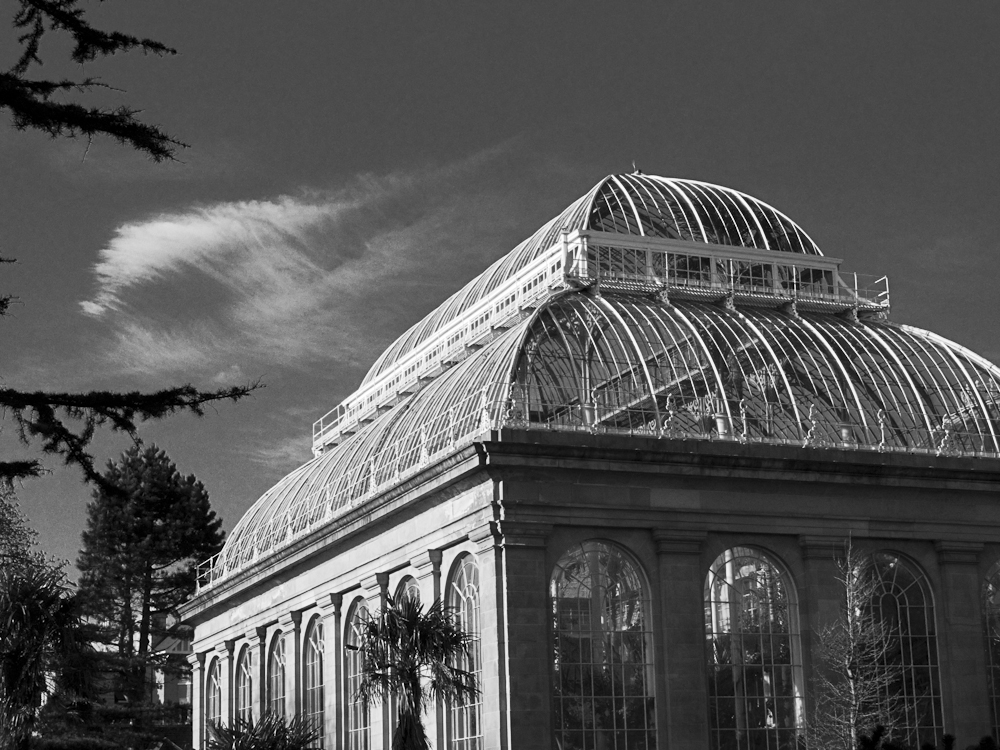 |
| Palm House, Edinburgh Botanics. I was attracted to the juxtaposition of the palm house against a dark blue sky and thought this would work in Black and White. I like the clouds here and used a polariser to enhance them. |
 |
| Not too sure if these two high key images of a rare elm tree fit here but I put them here for consideration. |
 |
| Lone Elm, High Key. |
Subscribe to:
Posts (Atom)